Seagrass Meadows, Ireland Case Study
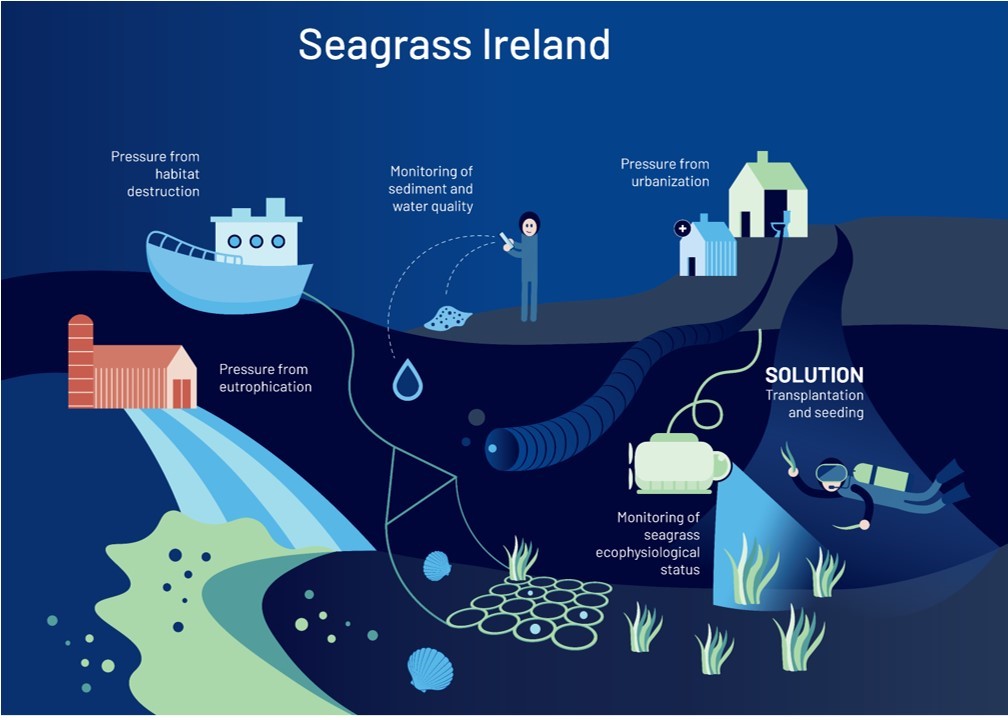
Infographic of the Ireland demonstration site

Case Study Components

Introduction to the site

Location: 53.7798 N, 7.3055 W

Observed ecosystem changes

Worldwide decline of seagrass meadow populations 1,2

CLIMAREST Objectives

Prevent meadows reduction and explore effective strategies for seagrass restoration in Ireland

Features of Ireland

  • Decline of sea meadows due to 3,4
    • coastal developmental projects
    • dredging
    • water pollution due to toxic contaminants
    • eutrophication by nutrients
    • introduction of invasive species
    • anchoring of marine vessels
    • farming

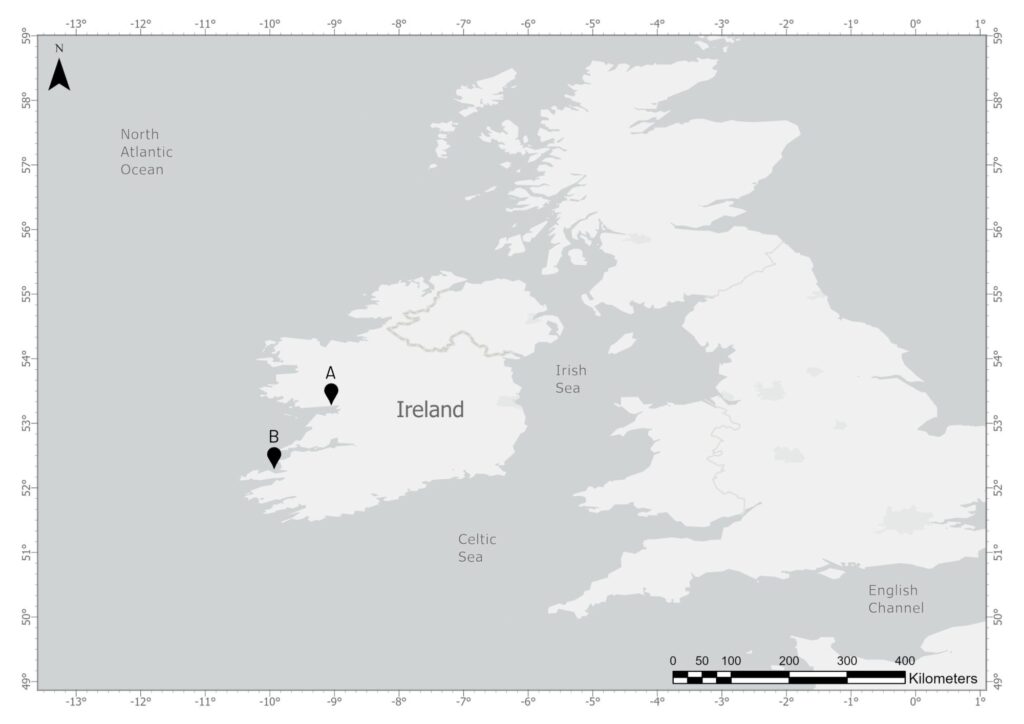
Map indicating the four restoration sites in Galway Bay (Lettercallow, Connemara), two in Tralee Bay (Fenit Island and Spa), and one in Killala Bay (Killala). 

Driving Factors and Motivations

The motivation for restoration lies in the fact that seagrass meadows are among the most valuable coastal ecosystems, providing essential services such as carbon sequestration, biodiversity support, and shoreline stabilization. Restoring these ecosystems is crucial to ensure the long-term health of our oceans and coastal communities.

Causes of decline:

  • pollution
  • coastal development
  • anthropogenic climate change

Black White Grey Round Monogram Typography Logo

Assessment Phase

Galway Bay Site

Selected after assessing size, shoot, density, water quality, and sediment stability

Area chosen with no significant pressures

Site environmental conditions similar to donor meadow

Tralee Bay Site

Close proximity to subtidal Zostera marina and intertidal Nanozostera noltei meadows

Strong stakeholder network

Small scale experiments of Nanozostera noltei showed promising results

Killala Bay Site

Favorably conditions for experimental work

Small scale trials showed promising results

Healthy donor meadow located nearby

Sites show minimal anthropogenic pressures, making them suitable for restoration efforts

Black White Grey Round Monogram Typography Logo (1)

Planning and Design Phase

Primary Objective: Restoration of degraded or lost seagrass meadows through transplantation

Objective 2
Refine seagrass restoration techniques and protocols to identify most suitable methods
Objective 3
Develop new methods and technologies for seagrass restoration, including earth observation monitoring, molecular studies
Objective 4
Enhance ecosystem services through seagrass restoration, including biodiversity maintenance, carbon sequestration, coastal protection
Objective 5
Involve local communities, policymakers, and stakeholders including education, citizen scientists, and conservation initiatives
Objective 6
Establish a monitoring program to track the success of restoration efforts, assessing seagrass coverage, health, and ecological function

Permits

Irish Department of Housing, Local Government, and Heritage

  • Marine scientific permits needed for all three bays

Maritime Area Regulatory Authority (MARA)

  • As of July 2023, MARA has taken over all marine consenting functions in Ireland
  • The creation of this new agency may create delays in obtaining permits for future restoration and scientific projects 

Relevant EU regulations

EU Nature Restoration Law

  • Sets legally binding targets for restoration of degraded ecosystems
  • Member States are required to restore at least 20% of EU land and sea areas by 2030

Habitats Directive (92/43/EEC)

  • Includes Zostera spp. 
  • Requires strict protection and conservation measures for Natura 2000 sites

Marine Strategy Framework Directive (2008/56/EC)

  • Mandates achieving Good Environmental Status (GES) of marine waters 
  • Seagrass meadows serve as a key indicator of ecological quality

Developing Project Protocols
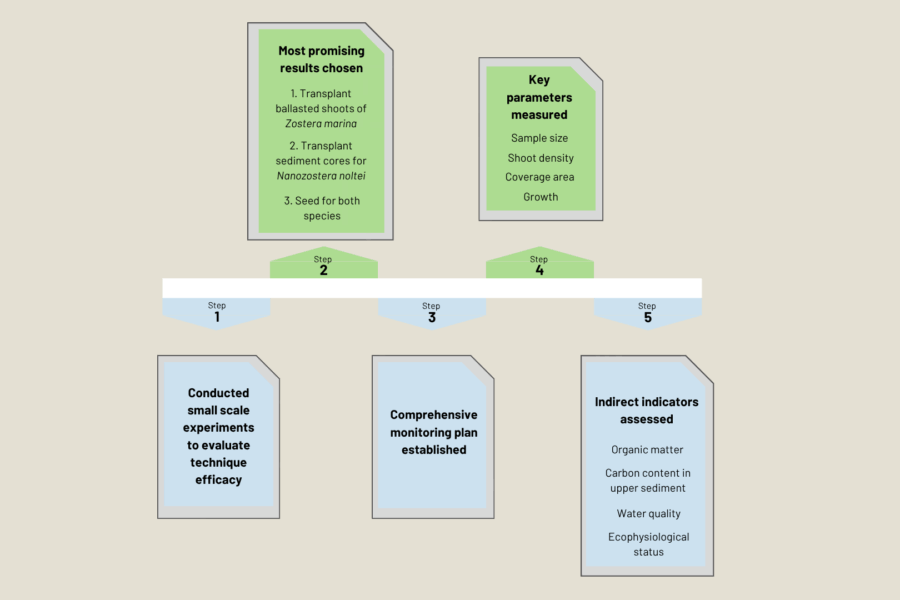
<em> Steps utilised in the restoration protocol of the Irish demonstration sites
Steps utilised in the restoration protocol of the Irish demonstration sites
Black White Grey Round Monogram Typography Logo (2)

Implementation Phase

Implementation Process

Select site

Based on environmental suitability, with reference sites established at key locations within the study areas

Transplantation into the field

Zostera marina: Healthy shoots weighted and planted in pre-dug sediment plots

Nanozostera noltei: Sediment cores extracted using core sampler, cores relocated to targeted restoration areas

Seeding

Seed dispersed on prepared sediment beds under controlled conditions

Monitoring and Data Collection Process
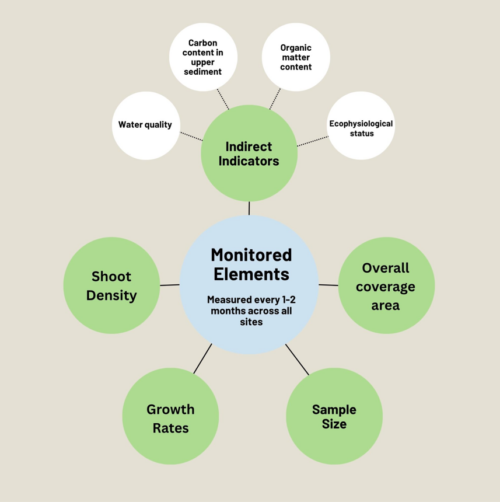
<em> Ecological elements monitored during the monitoring phase of restoration
Ecological elements monitored during the monitoring phase of restoration

Measurement with calibrated tools

    • Rulers
    • Measuring tapes
    • Quadrats

Sediment core extraction

Sampling of filtered and unfiltered water

Ecophysiological assessments

    • Visual inspections of plant health
    • Collection of leaf tissue for analysis of carbohydrates and nutrients

Timeline for data collection

<em> Figure showing the monitoring timeline of the project
Figure showing the monitoring timeline of the project
Black White Grey Round Monogram Typography Logo (4)

Ongoing Management, Monitoring, and Evaluation Phase

Initial results from the sites

Restoration Challenges

Galway Bay

Efforts disrupted by adverse weather
Typical examples: storms, heavy rainfall, and strong winds
Increased turbidity following storms
Complicates transplant monitoring and sampling
Seasonal Challenges
Winter challenge: Primarily storms Spring challenges: Temperature and seaweed blooms

Tralee Bay

Local activities threaten restoration success
Example: Vehicle traffic over transplanted meadows
Balancing interests of local conservationists
Concern over seed removal for conservation purposes. To mitigate these concerns, the team followed a strict protocol to minimise impact to donor meadows.
Changes in land-derived water flow
Occasionally this would damage transplants
Constraints on restoration
Examples: limited donor meadows due to lack of genetic data, invasive species, streams of fresh water, seaweed blooms and eutrophication, administrative hurdles

Killala Bay

Monitoring equipment lost or removed
Some equipment such as HOBO data loggers and markers have been lost or removed from the site
Constraints on restoration
Examples: limited donor meadows due to lack of genetic data, invasive species, streams of fresh water, seaweed blooms and eutrophication, administrative hurdles

Black White Grey Round Monogram Typography Logo (7)

Sharing and Communication

Map of Ireland with locations of stakeholder engagement

References

1. Waycott M, Duarte CM, Carruthers TJB, Orth RJ, Dennison WC, Olyarnik S, et al. (2009) Accelerating loss of seagrasses across the globe threatens coastal ecosystems. Proceedings of the National Academy of Sciences of the United States of America, 106:12377–12381. https://doi.org/10.1073/pnas.0905620106
2. de los Santos CB, Krause-Jensen D, Alcoverro T, Marbà N, Duarte CM, van Katwijk MM, et al. (2019) Recent trend reversal for declining European seagrass meadows. Nature Communications 10:1-8. https://doi.org/10.1038/s41467-019-11340-4
3. Nairn R, Robinson J (2003) All-Ireland Review of Intertidal Eel-Grass (Zostera) Beds. Natura Environmental Consultants & The Wildfowl & Wetlands Trust.
4. Green EP, Short FT (2003) World Atlas of Seagrasses. Prepared by the UNEP World Conservation Monitoring Centre. University of California Press, Berkeley, USA