Planning and Design

The planning and design component is extremely important, as it will ultimately determine the project's level of success. In addition to planning the physical project at hand, it is important to consider all levels of decision-making during this component, ensure that your planning and design is inclusive of all stakeholders, and to be fair and transparent to avoid conflicts 1.
Permits
An essential part of developing and implementing restoration actions is obtaining relevant permits from regulatory agencies. This process may seem daunting and there is no "one-size-fits-all" solution, but there are a number of resources available to consult for guidance.
There are multiple levels in which you may need to apply for permitting, including
- Local/municipal level
- Regional level
- National level
Permitting varies greatly from country to country and municipality to municipality. To start your permitting process, it is recommended to reach out to your local municipality regarding your project to get results tailored to your location. There, they can begin to guide you in what permits you may need across all levels.
Check out our case study pages to find more information on permitting within our projects
Funding and Financial Strategies
Securing adequate funding is a pivotal factor in the success of marine restoration projects. Recent analyses and case studies underscore that both the availability and strategic deployment of financial resources significantly influence project outcomes, scalability, and long-term sustainability 3, 4, 5.
The toolbox provides a Marine and Coastal Funding Database that compiles a range of available funding opportunities for habitat restoration, from local, national, and EU-wide public schemes to NGO and private funding. Looking at current funding opportunities and their strategies may also provide useful insights and practical examples on how to guide new initiatives.
While conventional sources, such as public projects remain the most frequent funding strategy, there is an increasing interest in engaging the private sector and exploring alternative financing mechanisms 6, 7, 8. To reflect this, the toolbox introduces innovative approaches such as blended finance, joint ventures, public-private partnerships, green bonds, carbon credits as well as opportunities related to biodiversity, drawing attention to high-impact project types. The goal is to help users explore financing options, learn different mechanisms, and support the development of partnerships that bridge funding gaps and ensure the sustainability of projects over the long term.
Every restoration project is unique, and success is very difficult to measure. The Society for Ecological Restoration takes the approach that each restoration initiative should be viewed individually and success criteria assertained on an individual basis. It is likely, therefore, that similar restoration projects will have different success criteria.
According to the SER International Principles and Standards for Ecological Restoration, a successful intervention:
"enables the recovery of biodiversity and ecosystem functions or services of a degraded ecosystem to values not significantly different than those in appropriate reference sites with relative intact, pre-disturbance structure, biodiversity and functioning" 2
The way in which a restoration intervention is a) considered successful 9 , and b) described as successful 10 is extremely varied, but the most common indicators can be summarised in the following categories 11, 2, 12, 13, 14:
- Survival of re-introduced native habitat-forming species
- Ecosystem functioning (eg. enhancement of metabolism, biomass, production, growth)
- Spatial expansion
- Local biodiversity
- Environmental quality
Varying ideas of success in restoration
| Author | Definition | Criteria |
|---|---|---|
| Bayraktarov et al. 201617 | Restoration is successful when ≥85% survival is achieved after 5 years; failure is ≤10% | Survival rate after 5 years: Success = ≥85% Failure = ≤10% |
| Gann et al. 2019 2 | Interventions where re-introduced habitat-forming species showed evidence of "survival" over time for the transplanted species | Survival (expressed as %) ranges from 0-100% |
| Fraschetti et al. 202116 | Restoration outcomes are classified as success, partial success, or failure | Success: 50% survival of restored organisms across the entire intervention area Partial success: Inconsistent outcomes across different metrics and species Failure: 10% survival of restored organisms |
| Smith et al. 202415 | Graded outcomes based on survival rate at 2 years | Poor outcome = <50% Below average outcome = ≥50-60% Acceptable outcome = ≥60% Excellent outcome = ≥80% |
| Danovaro et al. 202510 | Restoration success is defined by a 50% survival threshold | Unsuccessful = <50% Successful = ≥50% |
Barriers to Success
There are several barriers to success, including:
- Lack of standardisation of methodology for coastal restoration initiatives. This can include stakeholder engagement, decision making in site selection, restoration protocols, and monitoring and data collection methodology.
- Lack of comprehensive consideration of biophysical, political and socioeconomic factors. Defining and evaluating success requires attention to multiple dimensions, such as the degree of stakeholder involvement, the extent to which their objectives are met, and measurable changes in the ecosystem’s biophysical composition. However, determining how much change constitutes “success” is often complex. The breadth of information to be integrated, combined with the challenge of aligning diverse success criteria, frequently leads to gaps in consideration. As a result, important factors may be overlooked, creating significant limitations in assessing the overall success of a restoration project.
Tools to assist in defining success, despite barriers
International Principles and Standards for the Practice of Ecological Restoration, 2 ed.
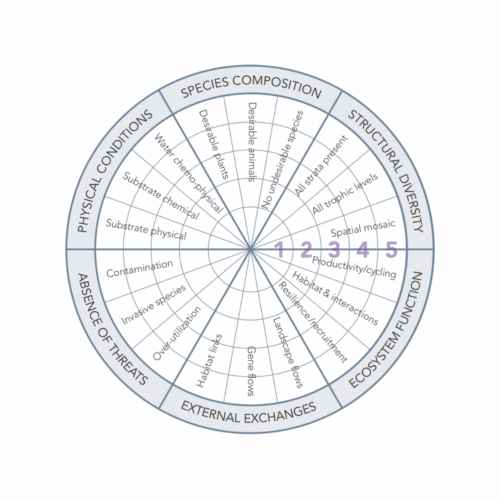
Currently, the eight International SER Principles 2 serve as a good foundation for ecological restoration and can be utilized to assist in guiding what success is for a restoration project. These eight principles are shown below.
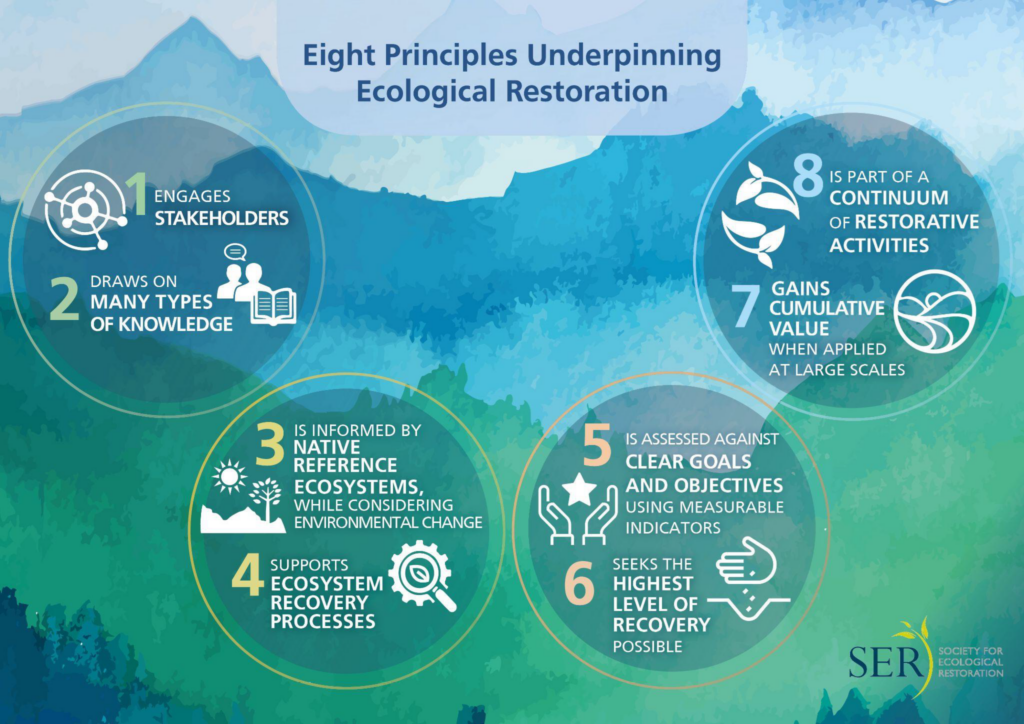
In line with these principles, CLIMAREST demonstration sites defined success criteria for ecosystems where restoration interventions were implemented. Rather than developing project-specific measures, CLIMAREST adopted criteria consistent with those set out by SER, ensuring that its evaluation framework was grounded in widely accepted international standards. From the eight SER Principles, three success criteria emerged as the most significant during both the demonstration and replication of restoration initiatives within the project:
- Success criterion 1: Application of developed and tested best practices for ecosystem restoration, alongside monitoring of interventions against reference ecosystems.
- Success criterion 2: Continuous stakeholder engagement throughout the restoration process, with sustained commitment beyond the lifetime of the project.
- Success criterion 3: Active commitment from political and socioeconomic sectors to support and facilitate restoration interventions.
For more detailed information on the demonstration and replication sites, see Case Studies (Macroalgae, Oysters, Seagrass Ireland, Seagrass Spain, Aquaculture and Lobster Restoration, Wastewater Treatment, Arctic Erosion).