Oyster Reef Restoration, Germany Case Study
Case Study Components




Introduction to the site
Location: 53.65 N, 6.50 E
Observed ecosystem changes
Functional extinction of Ostrea edulis reefs
CLIMAREST Objectives
Re-establish self-sustaining Ostrea edulis reefs
Features of Borkum Reef Ground
Located in a Natura 2000 marine protected area, offering legal and ecological support for restoration activities.
Historically supported extensive populations of European flat oyster (Ostrea edulis), now nearly extinct due to overfishing, habitat loss, and disease.
Characterized by sandy and mixed sediments with suitable hydrodynamic conditions for oyster restoration.
Map indicating the location of Borkum Reef Ground, the location of the replication site.
Driving Factors and Motivations
The European flat oyster used to provide essential ecosystem services such as water filtration, habitat provision, and shoreline stabilization. Due to overfishing, habitat destruction, and diseases, the species became functionally extinct in the German North Sea by the early 20th century. The restoration actions are motivated by the need to recover these lost ecosystem functions, enhance biodiversity, and contribute to climate resilience.
Aims of restoration efforts:
- develop scalable, science-based methods to restore self-sustaining Ostrea edulis reefs
- support marine restoration tools, best practices, and coastal policy across Europe

Assessment Phase
Elements for Site Selection
Ecological, legal, and technical evaluations from the RESTORE project
Analyzed environmental suitability
- Hydrographic surveys
- Sediment sampling
- Water quality
Ran seasonal field experiments for oyster...
- Growth
- Survival
- Health
Natura 2000 site designation provided legal protection from trawling activities


Planning and Design Phase
Primary Objective: To restore self-sustaining and reproductively viable populations of Ostrea edulis in the German North Sea
Germany Permits
German Federal Agency for Nature Conservation (BfN)
German Federal Maritime and Hydrographic Agency (BSH)
The BfN has published a report reviewing the legal framework for European flat oyster restoration in Germany
Relevant EU Permits
EU Nature Restoration Law
- Sets legally binding targets for restoration of degraded ecosystems
- Member States are required to restore at least 20% of EU land and sea areas by 2030
Habitats Directive (92/43/EEC)
- Requires strict protection and conservation measures for Natura 2000 sites
Marine Strategy Framework Directive (2008/56/EC)
- Mandates achieving Good Environmental Status (GES) of marine waters
Developing Project Protocols

Implementation Phase
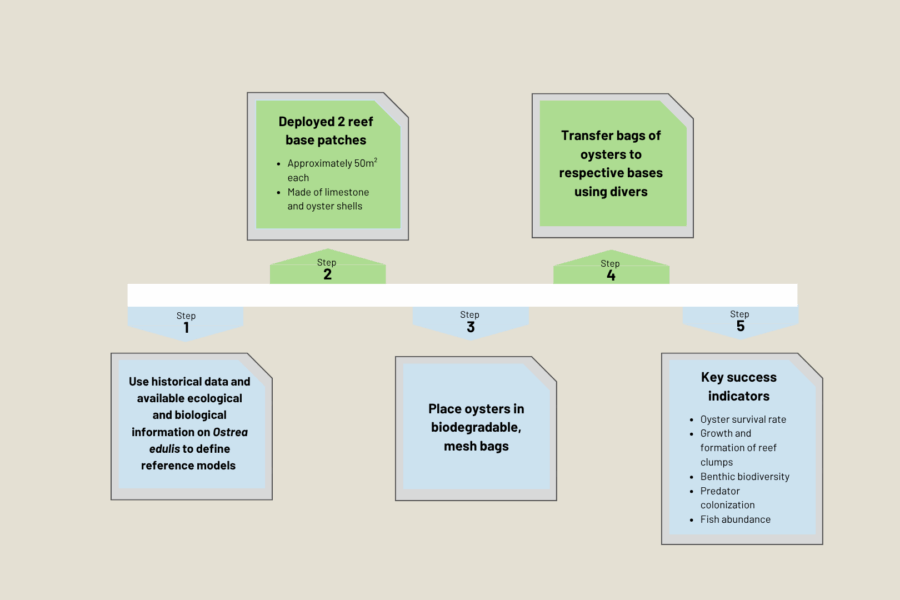
Implementation Process
Deploy the reef base and complete related underwater construction works
- Base made of limestone boulders to mimic a natural reef base and provide protection from mobile sand and wave actions
- The base was deployed using a multi-purpose vessel (MV Multrasalvor 4) 1
Place Ostrea edulis shells on top of reefs with divers to create potential settlement substrate
Introduce live oysters onto installed reefs using divers
- Spat-on-shell oysters
- Single seed juvenile oysters
- Adult oysters
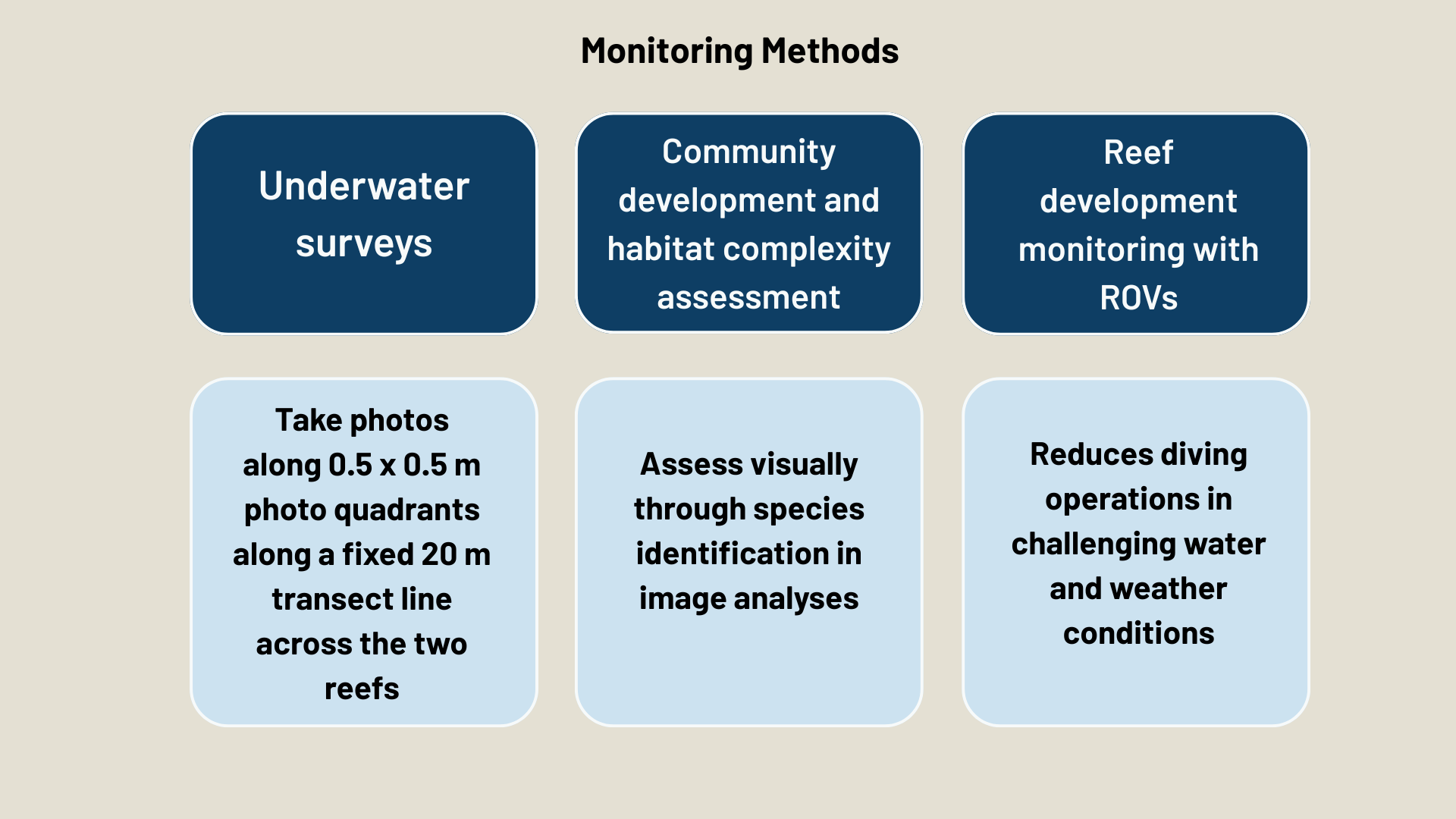
Monitoring and Data Collection Process
Ecological indicators measured
Presence of live oysters
Substrate coverage
Shell aggregation
Colonization by key benthic species
- Examples: brown crabs, fish