Macroalgal Forests and Sea Urchin Grazing, Madeira Case Study
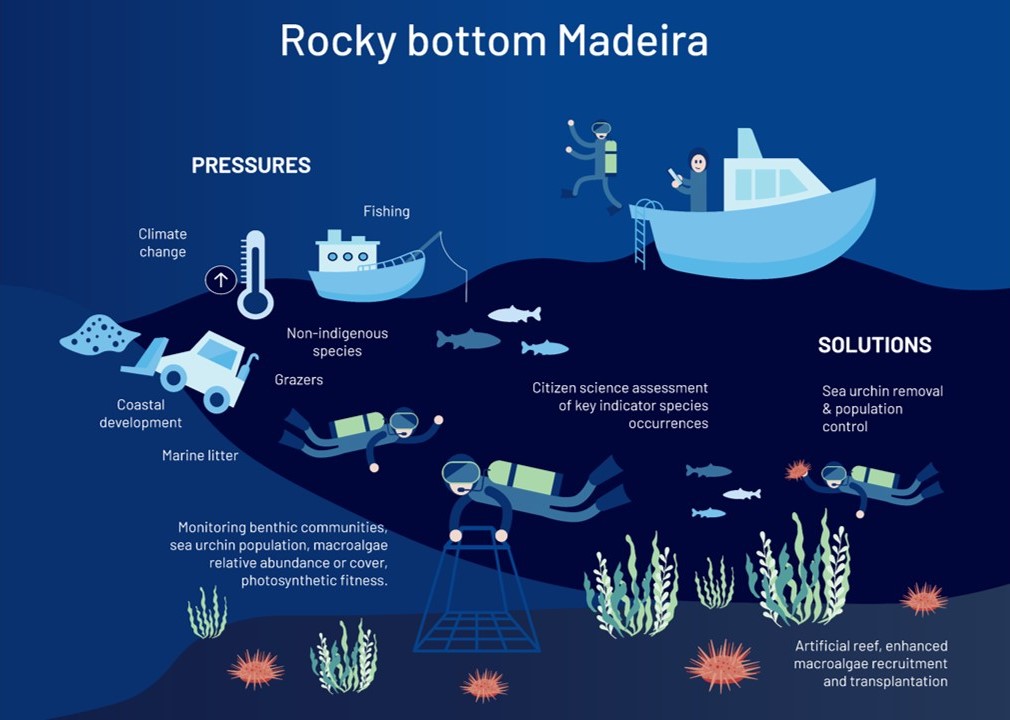
Case Study Components




Introduction to the site
Location: 32. 7607 N, 16.9595 W
Observed climate change impacts
Loss of macroalgae forests due to overpopulation of sea urchins
CLIMAREST Objectives
Restore macroalgae forests
Features of Madeira
Includes inhabited islands of Madeira and Porto Santo, and the uninhabited islands of Desertas and Selvagens
Submerged habitats characterized by rocky reefs and sandy bottoms, with occassional seagrass patches
Unique blend of temperate and tropic species, typical of subtropical regions
Map indicating Madeira island, located southwest of Portugal.
Driving Factors and Motivations
The restoration of macroalgal forests in Madeira is driven by concerns over their decline due to multiple stressors, including
- overgrazing by sea urchins
- habitat degradation
- anthropogenic climate change
- coastal development
These forests are vital to the island’s shallow marine ecosystems offering habitat, food, and nursery grounds that support marine biodiversity and ecosystem resilience.
A healthy macroalgal forest can support local fisheries, improve water quality and contribute to carbon sequestration.
Aims of restoration efforts
- enhance ecological function, by re-establishing canopy forming species

Assessment Phase
Key Criteria for Site Selection
Accessibility of site
Availability of ecological data from previous studies
Strong local support from nearby dive centers as key stakeholders


Planning and Design Phase
Primary Objective: Increase native macroalgae cover (Sargassum spp.) using forestation techniques
Permits
Regional Institute for Nature Conservation and Forests (IFCN)
- Two-year license for marine protected area sites
- Used for three month monitoring program
- Information needed: planned diving activities, names of divers
IFCN online forms
- Completed before each survey
- Information needed: Location, date, hours, number of divers, and the license plate registration of the boat supporting the activities
Captaincy of the Port of Funchal
- Special permit needed to deploy modular eco-concrete seawalls
Relevant EU regulations
EU Nature Restoration Law
- Sets legally binding targets for restoration of degraded ecosystems
- Member States are required to restore at least 20% of EU land and sea areas by 2030
Habitats Directive (92/43/EEC)
- Requires strict protection and conservation measures for Natura 2000 sites
Marine Strategy Framework Directive (2008/56/EC)
- Mandates achieving Good Environmental Status (GES) of marine waters
Developing Project Protocols


Implementation Phase
Implementation Process
Collect fertile material
Gather fertile branches/receptacles from natural Sargassum populations
Process in lab for zygotes
Extract zygotes for cultivation
Seed zygotes
Plant zygotes on substrate units of nature-based materials such as natural rock, terracotta, and ceramic
Culture substrates
Culture algae under controlled conditions to promote germling growth
Transplant to Modular Artificial Reef Structure (MARS) units
Transfer juvenile algae to MARS units at restoration sites
Submerge MARS units at restoration sites
Coordinate the submerging process with local dive centres and relevant local authorities
Each of the four sites host three MARS, resulting in...
Monitoring and Data Collection Process
Methods for data collection
Scientific
- Photoquadrats and point counts for sessile and benthic organisms
- Underwater visual census (UVC) along fixed transects to assess mobile fauna
Citizen Science Monitoring of 24 pre-selected species and their abundance using the Dive Reporter App
Ecological indicators measured
Species Diversity
Species Abundance
Species Density


